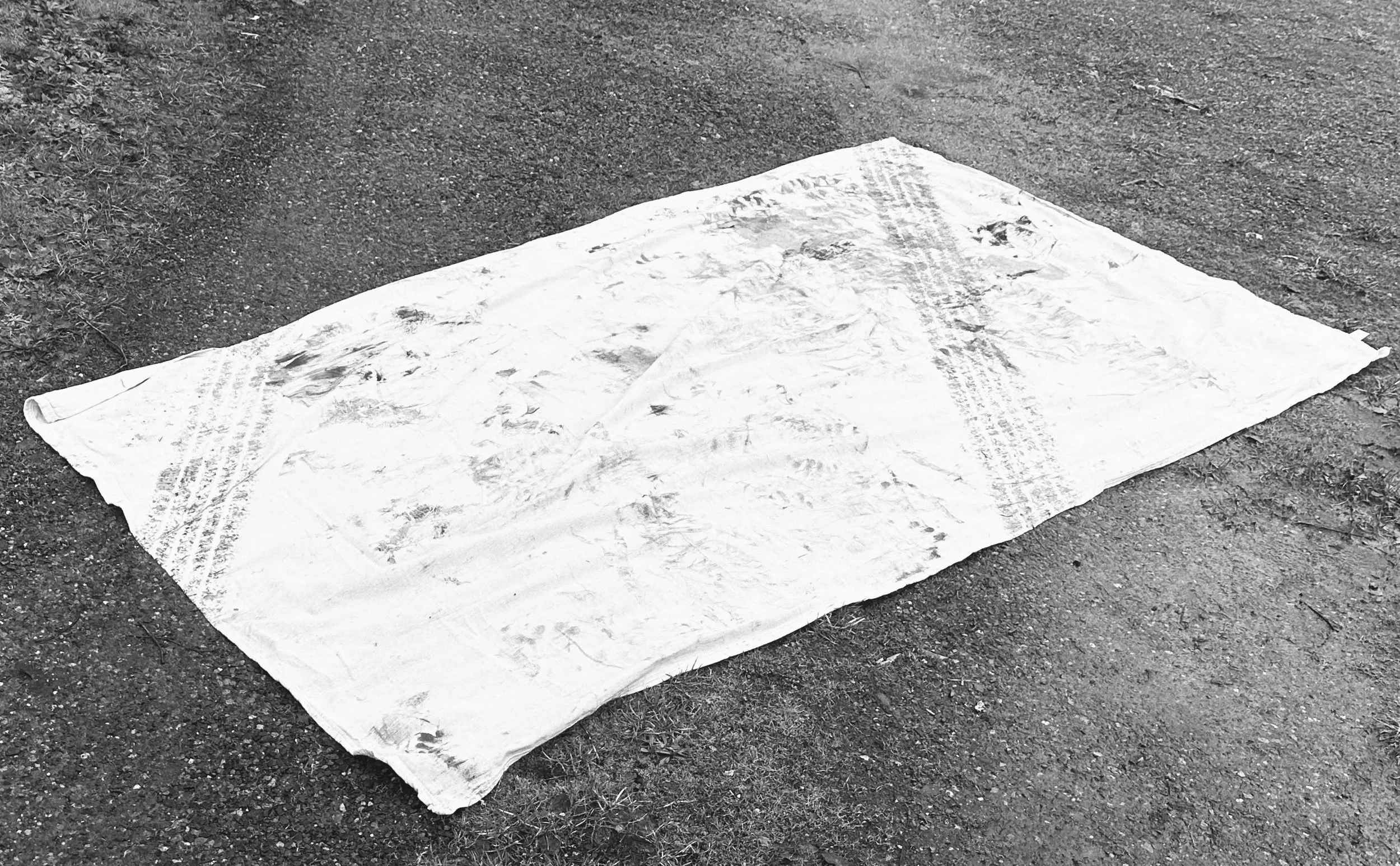
Edifice εφημερίδα
My work examines the fundamental components from which meaning is constructed: the point and the line, the mark and the gap, letters, words, punctuation, and images. These elements function not only as tools of communication but as material units whose aggregate determines legibility, coherence, and belief. A letter whose aggregate is discordant becomes unreadable; a misspelled word distracts; a paragraph built from unstable phrases collapses into a weak or illogical argument. Meaning, at every scale, depends on the fragile success of its assembly.
I extend this logic beyond language into broader systems of interpretation. Reading text is not unlike reading constellations, tea leaves, or oracles—frameworks in which fragments are gathered into an aggregate and animated through interpretation. Points become stars, stains become symbols, marks become omens. Meaning is not inherent to the parts but emerges through connection, mediation, and projection, often guided by cultural habit, superstition, or professional authority. These systems are fallible by nature, yet we routinely treat their scaffolding as fixed and trustworthy.
This idea of aggregation operates as both metaphor and method within my practice. I create my own constellations from chance actions—sprinkling salt, dispersing liquid paint with a toothbrush—producing fields of dots that stand in for stars, universes, or data. These points can be connected in innumerable ways, allowing any image, narrative, or cosmology to be imposed. The resulting forms reveal how easily order can be authored, how convincingly meaning can be drawn from randomness when an interpreter asserts coherence.
Materially, this logic continues through my use of cement whose aggregate includes crayons, small toys, and other nontraditional building materials. Here, the language of architecture mirrors the language of text: strength, stability, and failure are determined by what is combined and how. I also incorporate painted stones bearing stenciled poems, quotations, and prompts—fragments of language embedded within mass. Each stone functions as both object and sentence, contributing to a larger structure whose meaning is contingent, cumulative, and subject to fracture.
I frequently use newspapers as both material and system: through collage, tape transfers, erasure, and the breakdown and reassembly of words. While this approach nods to Dadaist strategies, my intent is not to emphasize absurdity or chance for its own sake. Instead, the newspaper functions as a dense aggregate of information variables—facts, implications, omissions, bias, urgency, and noise. By fragmenting and reconfiguring this material, I address the contemporary attempt to extract meaning from an informational abyss, where clarity is implied, authority is assumed, and coherence is often constructed after the fact.
The title pairs the architectural term edifice with εφημερίδα (efimerida), the Greek word for newspaper, closely related to “ephemeral”—something that lasts only briefly, sometimes only a day. This pairing underscores the paradox at the center of my work: we construct enduring structures of belief from materials and stories that are temporary, provisional, and often unstable.
This cycle of construction and deconstruction lies at the heart of my practice. Before a story exists, there is an impulse to assemble—to gather points, marks, fragments, and symbols into an aggregate that can be read. Over time, the narrative decays, authority shifts, and the structure erodes. Its materials are dispersed, recycled, or reinterpreted, becoming the foundation for the next edifice.
My images and objects occupy this liminal state—aggregates on the verge of coherence or collapse. By isolating these in-between moments, I create space for discrepancy, subjectivity, and reinterpretation, revealing how meaning is always contingent on fallible components and how deeply we rely on assembled systems, even as they quietly fail beneath us.